Quick Summary
Treat GMAT CR paragraph completion as finishing the whole argument, not the last sentence. Skim, build a quick mind map, and weigh positives and negatives. Prefer balanced, moderate endings that reflect all points, avoid extreme or prescriptive language, and logically complete the reasoning.
Overview
Paragraph completion questions ask you to finish the argument, not merely its last sentence. This overview frames the goal: read the paragraph holistically, sketch a quick structure, and choose a continuation that reflects all points with measured, non-prescriptive language. You will see how balance, scope, and logical flow guide the best endings, setting up the video and the detailed article that follows. These habits cultivate disciplined reasoning in GMAT prep and clear, evidence-based writing across MBA admissions for analytical clarity.

GMAT CR: Paragraph Completion Question Type
Understanding Paragraph Completion Questions on the GMAT
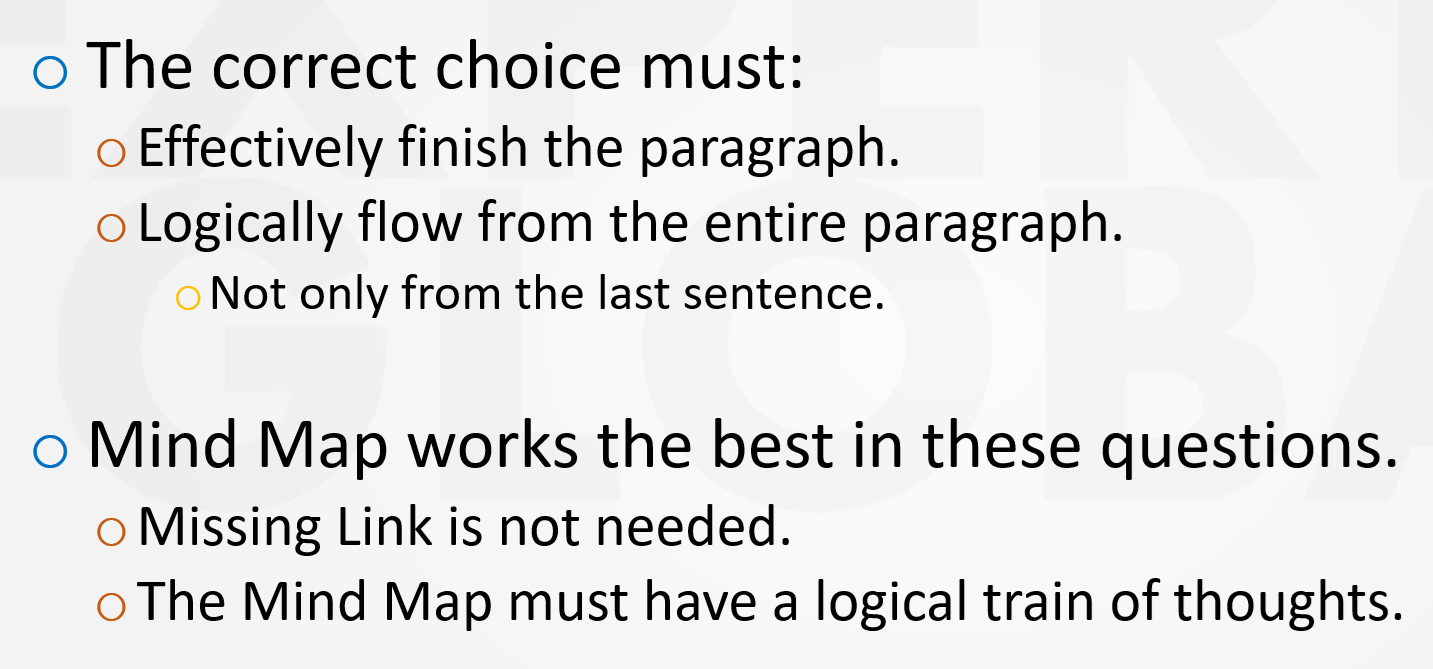
Paragraph completion questions in GMAT Critical Reasoning may seem straightforward at first glance, but they often test the depth of your logical reasoning. The correct answer is not simply a sentence that sounds good at the end. It must capture the essence of the entire paragraph and logically conclude the reasoning without exaggeration or bias.
GMAT Critical Reasoning Paragraph Completion Questions: What They Look Like
Expect an incomplete passage with layers, twists, and turns. Your task is to select the answer choice that best completes the argument.
Typical Question Stem
- Which of the following best completes the passage?
How a Paragraph Completion CR Question Appears on the GMAT
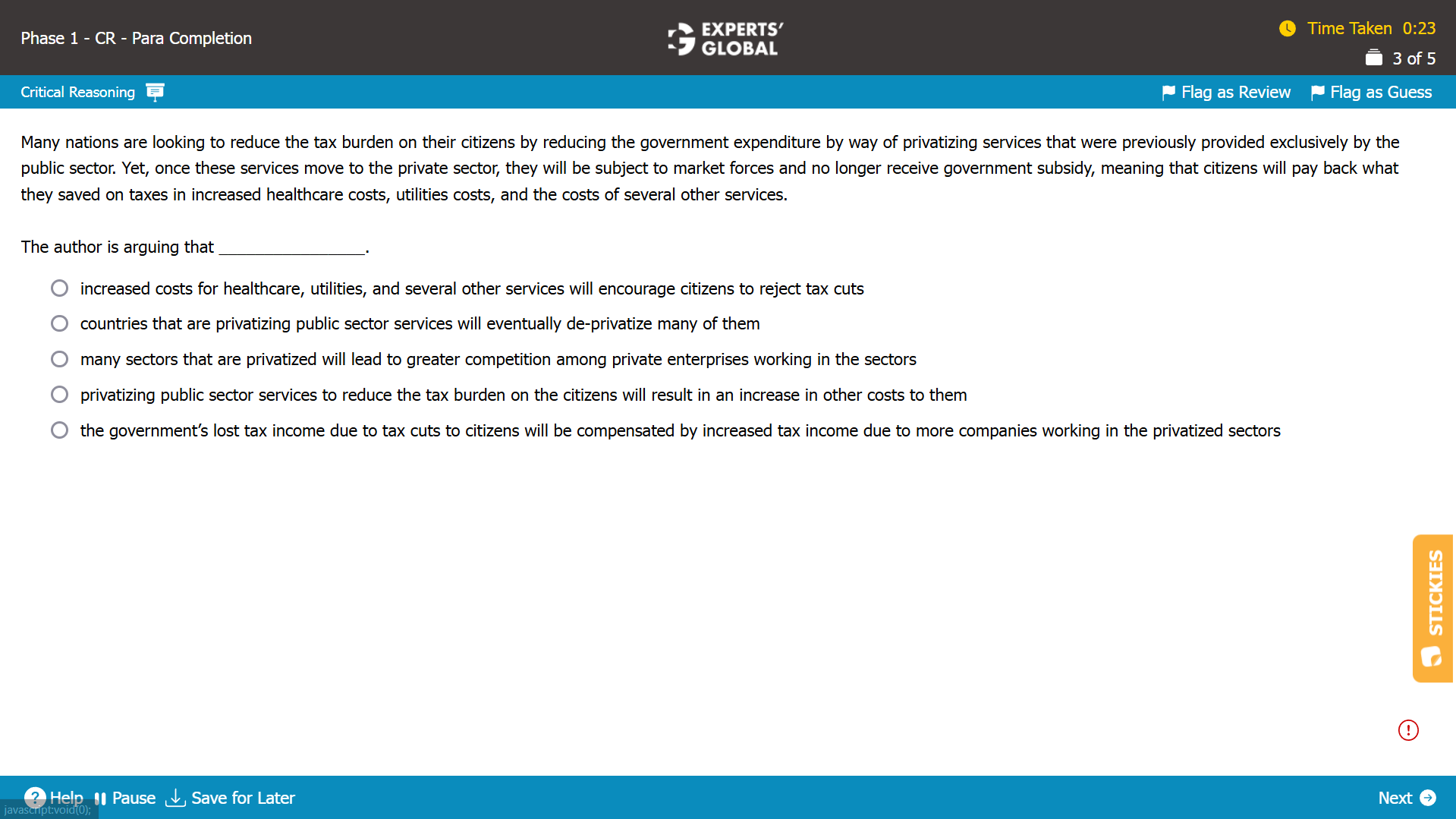
Correct Answer: D
Why the Whole Paragraph Matters
A common mistake students make is to focus on the last sentence when choosing an answer. This often leads to unbalanced choices that highlight only part of the argument. The right approach is to recognize that the conclusion must flow naturally from the entire paragraph. That is why building a quick mind map is so helpful – it keeps track of both the positive and negative points, ensuring you do not favor one side disproportionately.
An Illustrative Example
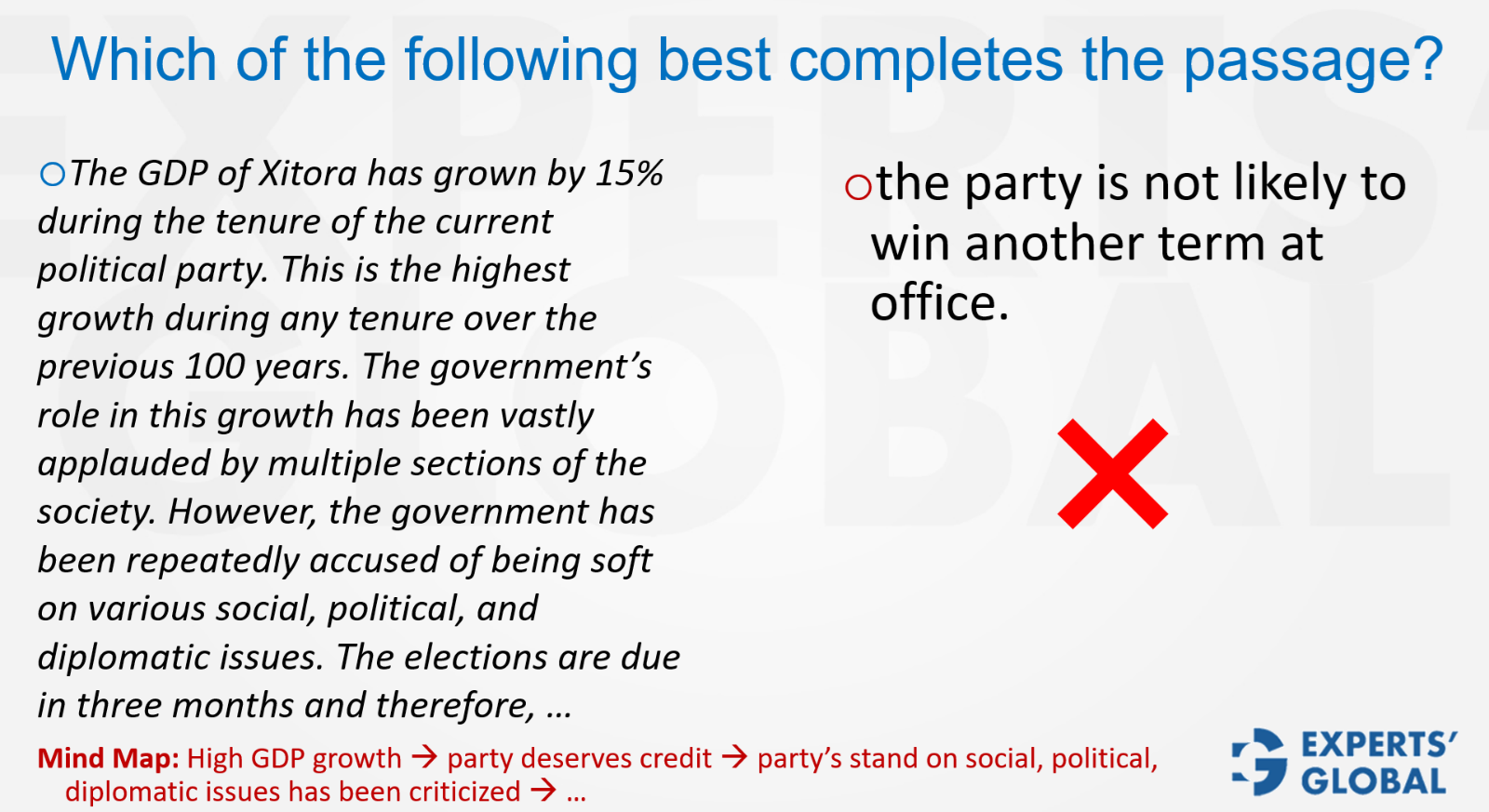
Consider this incomplete passage:
“The GDP of Xitora has grown by 15% during the tenure of the current political party. This is the highest growth during any tenure over the previous 100 years. The government’s role in this growth has been vastly applauded by multiple sections of the society. However, the government has been repeatedly accused of being soft on various social, political, and diplomatic issues. The elections are due in three months and therefore,…”
Now, let us evaluate some answer choices:
- “The party is not likely to win another term.” This leans heavily on the negative half of the paragraph and ignores the positives, making it unbalanced.
- “The party’s economic policies must be lauded.” This gives importance only to the positives and disregards the criticisms, making it equally flawed.
- “The voters must analyze the party’s performance.” This is weak because the paragraph itself is already an analysis.
- “The public must demand greater government action.” This is overly prescriptive and adopts a patronizing tone, which is rarely correct in GMAT answer choices.
- “It is difficult to predict whether the party will win another term.” This strikes a balance between the positives and negatives. It acknowledges the uncertainty, making it a strong answer.
- “To improve its chances, the party must take corrective action on socio-political issues.” This also works well because it connects the positives and negatives and logically points toward a constructive step.
The correct completion is always moderate in tone, captures the full scope of the paragraph, and avoids absolute claims.
Core Strategy to Apply
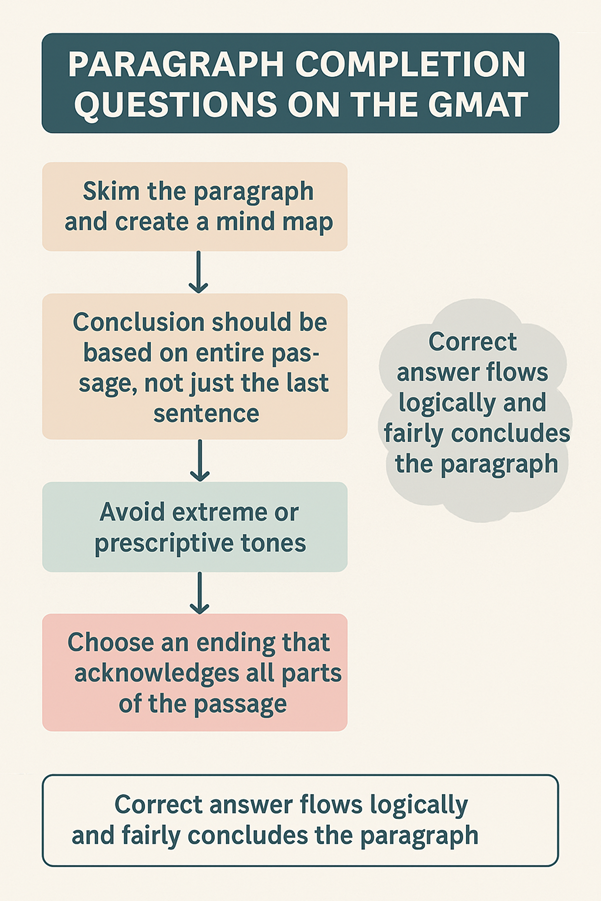
- Skim the entire paragraph and create a mind map.
- Build a broad expectation from the correct answer choice.
- Ensure the conclusion is not based solely on the last sentence.
- Avoid extreme or prescriptive tones unless clearly warranted.
- Choose an ending that acknowledges all parts of the passage.
GMAT-style CR Paragraph Completion Question with Explanation
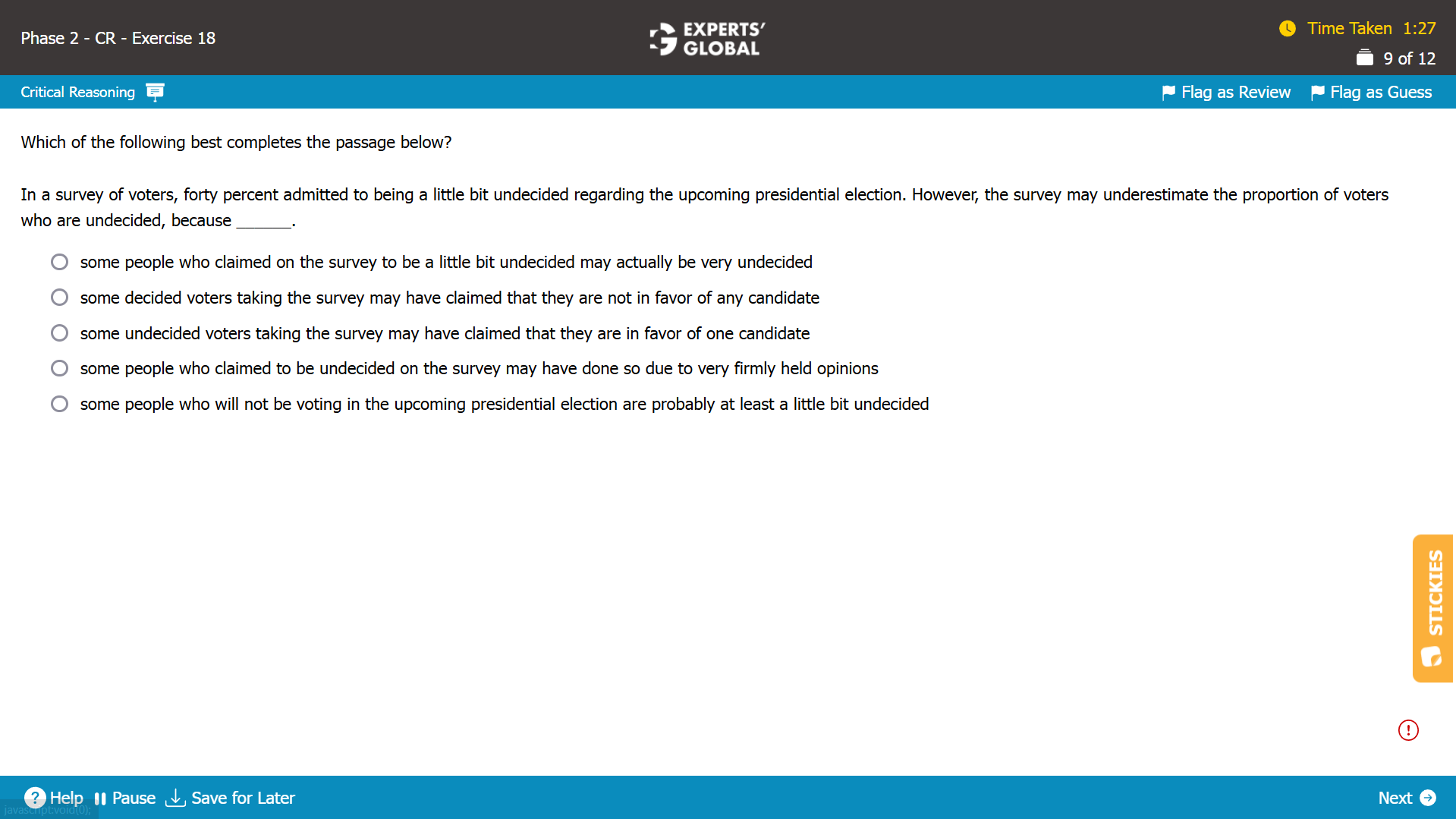
Written Explanation
Mind-map: Forty percent voters admitted to being undecided → proportion of voters who are undecided may be undervalued because _____
Missing-link: Between forty percent voters admitting to being undecided and the proportion of voters who are undecided being undervalued
Expectation from the correct answer choice: Something on the lines of some voters who are undecided responded in the survey that they have made a decision
a. The argument is concerned with the count/proportion of undecided voters and not with the degree of undecidedness; so, even if some undecided voters claimed to be somewhat undecided but were more undecided than they claimed, the voters, on account of they claiming to be undecided, were counted as undecided voters, thus resulting in the survey likely making the correct estimation, rather than an undervaluation, of the proportion of undecided voters. Because this answer choice does not effectively complete the chain of thoughts developed in the passage, this answer choice is incorrect.
B. If some decided voters taking the survey may have claimed that they are not in favor of any candidate, it indicates that some decided voters got counted as undecided voters, thus resulting in the survey overestimating, rather than undervaluing, the proportion of undecided voters; such a possibility contradicts the fact in the argument that the survey may undervalue the proportion of undecided voters. Because this answer choice does not effectively complete the chain of thoughts developed in the passage, this answer choice is incorrect.
C. Correct. If some undecided voters taking the survey may have claimed that they are in favor of one candidate, it indicates that some undecided voters got counted as decided voters, thus resulting in the survey undervaluing the proportion of undecided voters. Because this answer choice effectively completes the chain of thoughts developed in the passage, this answer choice is correct.
D. The argument is concerned with the count/proportion of undecided voters and not with the reason for being undecided; so, this answer choice, suggesting a reason for being undecided, is just additional information and makes no suggestion regarding why the survey may undervalue the proportion of undecided voters. Because this answer choice does not effectively complete the chain of thoughts developed in the passage, this answer choice is incorrect.
E. The argument is concerned with the survey of “voters” and not with “those who will not be voting”; so, the decidedness of non-voters is out of scope. Because this answer choice does not effectively complete the chain of thoughts developed in the passage, this answer choice is incorrect.
C is the best choice.
Key Takeaways
Paragraph completion questions require capturing the essence of the entire passage, not just echoing the last line. The correct option balances positives and negatives, avoids extremes, and continues the reasoning with a moderate tone. Building a quick mind map ensures no detail is overlooked. The task is to complete flow, not add rhetoric. Practicing these strategies in GMAT simulations helps refine judgment, sharpen logical continuity, and develop the discipline to select balanced, context-aware endings under exam pressure.
Parting Thought
Paragraph completion questions remind us that true judgment requires balance. In GMAT preparation, the task is not to be swayed by one strong detail but to weigh the whole argument and conclude with fairness. In MBA applications, the same discipline applies – committees value candidates who integrate strengths and acknowledge challenges, presenting a complete narrative. In life, too, wisdom lies in conclusions that respect complexity rather than extremes. Each GMAT mock offers practice in striking this balance, nurturing clarity and moderation that extend far beyond the test.